Gavin McLead, Emotive CCO: How surfing has made me rethink my job.
Written by Gavin McLeod, Emotive CCO
I’ve been lucky to travel for years with a tight group of friends.
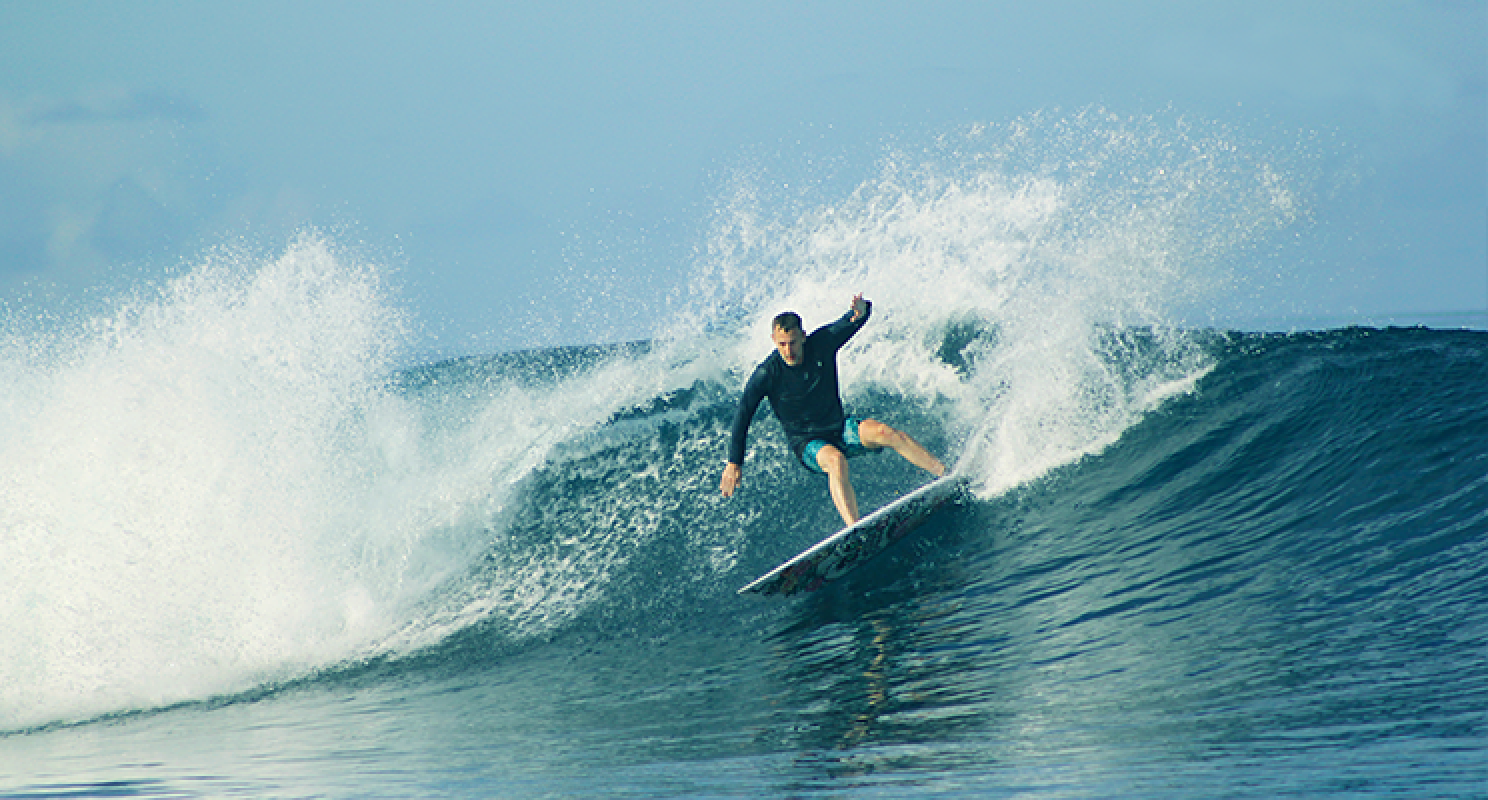
We started surfing together in our 20s, and every couple of years we still manage to sneak off somewhere with warm water and waves that push us just past our comfort zone.
On a recent trip to a remote corner of Indonesia, we arrived bleary-eyed at the surf camp, dumped our bags, jumped into a motorboat and went straight out. The first session was magic. Empty line-up, that familiar mix of joy and panic when a big set rolls through.
Afterwards, the local surf guide came up to us.
“I thought you were the usual bunch of old guys. Just come here, drink lots of beer, and talk about the old days,” he said.
“But you guys rip. Surf pro level.”
Just to be clear, we do not surf pro level. Not even close.
But surfing has been a long love affair for me. Equal parts thrill, humility, and bruised ego.
When Passion Meets Physics
It’s an intensely physical sport.
And as the years add up, so do the creaks.
I’ve started noticing the difference; my body doesn’t recover the way it used to, and the moves that were instinctive now require conscious effort.
So I’ve had to adapt.
These days I train. Reluctantly.
I don’t love training. I love surfing.
But I’ve realised that if I want to keep doing the thing I love, I need to work at it. Even when it feels like work.
The Advertising Parallel
Lately I’ve been feeling that this is exactly where advertising is right now.
We’re in a period of massive change.
AI isn’t just a shiny new toy. It’s rewriting how creative work happens.
And if we want to keep doing what we love — the idea-making, the storytelling, the craft — we need to relearn how we work. That’s something we’ve been leaning into at @Emotive Creative Agency. Not as a side project or a quick experiment, but as a genuine shift in how we create.
I don’t mean dabbling.
I mean really committing to it.
And honestly, I’ve had to push myself.
Because the moment someone tells me I have to do something, like “You must learn prompt engineering!”, my instinct is to resist.
But avoiding it isn’t an option.
Every agency, every creative team, every one of us is being reshaped by this shift. Ignoring it won’t slow it down. It’ll just leave us paddling behind the wave.
Learning the New Craft
My LinkedIn feed is a blur of “Top 30 AI courses you must do this year.”
And they’re probably right.
But lists don’t change you. Practice does.
So I’ve been building my own version of a learning plan.
Nothing formal. Just small things that push me to explore, experiment and get comfortable being bad at something new.
Sometimes a tool helps me mock up an idea faster.
Sometimes it helps me think in new ways altogether.
Either way, I end up spending less time on the mechanics and more time on the magic.
What I’m Learning Next
If I’m honest, the list of things I could learn right now is overwhelming.
Every week there’s a new model, a new course, a new must-try tool.
It’s easy to start feeling like the slowest person in the room.
So I’m taking a different approach. I’m keeping it small and steady. Things I can actually do between briefs, projects and a life. The goal isn’t to know everything. It’s to keep moving without burning out.
The Six Month Plan (ish)
I’ve started linking specialist ChatGPT agents and it’s already changing how I work. The next step is figuring out how to get them working together to automate full processes. Watching how this could scale across Emotive feels properly transformative.
What I’m Focusing On
1.Learn smarter
I’m on the waiting list for Oxford’s short course on Generative AI for Creative Professionals. Six weeks, two-hour online lectures, and brutal time zones for anyone in Australia. If I show up to meetings looking like a zombie and clutching coffee, that’s why. Mostly, I just want a clearer view of how AI fits into the creative process, not just the output.
2.Tell better stories
We’re collaborating with AiCandy and some incredible AI creators on a new client film. It’s letting us pull off a script we couldn’t have imagined before. And it’s inspired something personal: I’m setting myself the goal of making my own short film using the full AI toolbox
3.Build something new
I want to create a custom GPT for visual exploration. To see how close I can get to Midjourney-level art direction. It might flop. It might fly. Either way, I’ll learn.
4.Read and listen critically
I’ve started AI Snake Oil, a sharp and skeptical take on the hype, written by two Princeton researchers. It fits my kind of optimism: hopeful but wary.
Next up is The Alignment Problem, which dives into how we teach machines to “do the right thing.” That one might need to wait until the Christmas break.
For the commute, Fuse: The AI Creative Podcast and AI for the Creative Mind have been great listens. Smart, practical, and full of real world tips. The AI co-host in Creative Mind is painfully awkward at first, but it’s fascinating to hear her improve over time.
That should keep me curious without tipping into overwhelm.
It’s not a perfect plan, but it’s one I can actually do.
So that is how I am approaching it. Keep showing up. Keep learning a little. Keep testing things that might fall apart. It is the only way I know to stay close to the wave rather than watch it pass from the shoulder.
Because in this climate, the question isn’t who is brilliant.
It is who is still learning.